

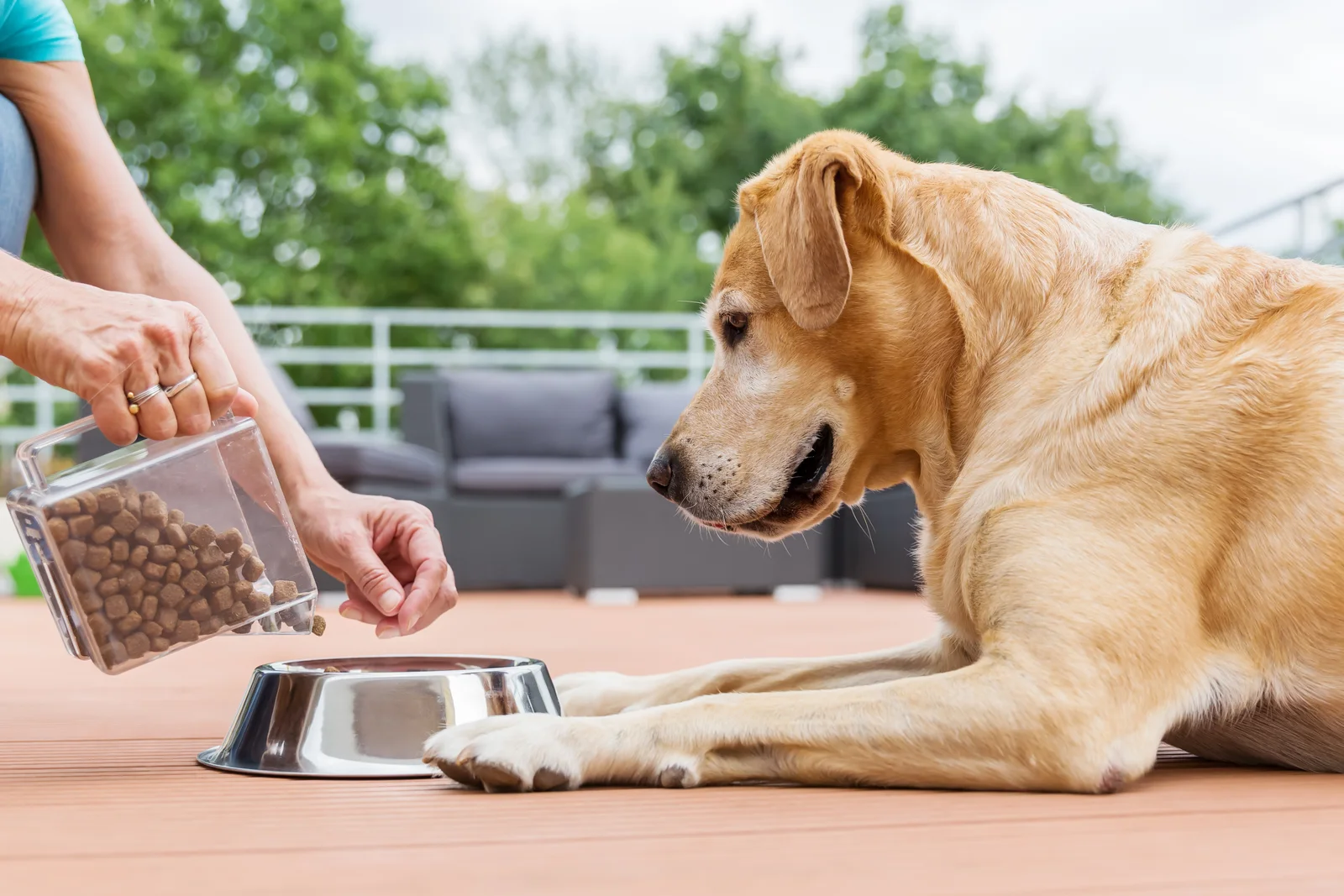
Agree what and how much to feed with your vet, turn it into portions you can measure, and keep a record of what was actually offered and eaten. That gives both your household and your vet something more useful than a guess.
Start with a plan for your dog
Ask your vet to help choose a diet and feeding amount for your dog as an individual. Age and life stage, breed and size, activity, current weight, body and muscle condition, sex and spay/neuter status can all inform the assessment. Pregnancy, nursing, health conditions and medication can also change the conversation. WSAVA nutrition resources
Bring the details of their current food and everything else they eat. Ask which food is appropriate, the daily amount, how to divide it into meals, what extras fit, and when to review the plan. A suitable calorie total alone does not establish that a diet meets their nutritional needs. AAHA feeding guidance
Turn the plan into measurable portions
Write down the exact food, the amount and the unit together. “One serving” leaves more room for interpretation than a measured portion of a named food. Ask the veterinary team to explain the measure they recommend and demonstrate it if needed.
Food calorie density matters: the same weight or volume of two different foods may provide different calories. Check the specific product information rather than carrying a portion across to a different food. If the label is unclear, ask the manufacturer or your vet. AAHA feeding guidance
Keep the agreed instructions where feeding happens. A note beside the food container is easier to use than a plan buried in a message from last month. Date the instructions so old portions do not quietly become the current plan.
Give treats a place in the plan
Include treats, chews, table food and food used to give medication in the diet history you discuss with your vet. Ask how these fit alongside the main food. They are part of the intake, even when they arrive outside mealtimes. AAHA feeding guidance
Make the household rule concrete: which extras are agreed, how much is available, and where to record them. If several people train or walk the dog, decide how everyone will know what has already been given. The same rule should reach the sitter and the visiting relative.
Make “already fed” easy to check
Agree who handles each meal and where the completed feeding is recorded. Use a notebook, a kitchen checklist or another record everyone can reliably access. Mark the meal after feeding, rather than when someone intends to do it.
Record the date, time, food, amount offered, leftovers and the person who fed them. Offered and eaten are different things if food is left in the bowl. Add extras in the same place so the daily picture is not split between several memories.
If you are unsure whether a meal was given, check with the person responsible before filling the bowl again. If the uncertainty cannot be resolved, ask your veterinary team what to do for your dog, particularly if feeding is tied to medication or a medical condition.
What can calorie records tell you?
In pawtrck, meal and treat entries can help you keep track of portions and logged calories. Diet also shows calorie progress and weight records. Use those records to notice repeated patterns and prepare clearer questions for your vet.
Being above or below an app estimate does not, by itself, prove overfeeding or underfeeding. An unlogged treat, an unfinished meal, a portion entered in the wrong unit or a calorie value from a different product can change the comparison.
Pawtrck’s estimated daily calorie target uses weight, activity level and spay/neuter status. It does not include every factor your vet assesses. Keep the agreed feeding instructions alongside your record, and ask your vet about a persistent mismatch rather than automatically changing portions to match the app.
Exercise calories are estimates too. Do not automatically add them back as extra food after a walk. Discuss activity changes as part of the feeding plan.
Your feeding-plan and handover worksheet
Complete the plan with your veterinary team’s advice, then use the daily handover space to keep feeding clear. It is a place to record agreed instructions, not a calculator or a prescription. Print a fresh copy when the plan changes.
Review the plan with your vet
Ask when to check weight and how to assess body and muscle condition. Share the food record, including leftovers and extras. Review the plan if your dog’s health, life stage or activity changes. WSAVA nutrition resources
If you are worried about unexpected weight change, reduced appetite or your dog seeming unwell, contact your vet rather than trying to solve it by adjusting a calorie total. A feeding log can support that conversation; it cannot explain the cause.
The aim is a plan you can follow and a record you can trust. Everyone knows what goes in the bowl, what has already been given, and when it is time to ask for help.
Back to top ↑